
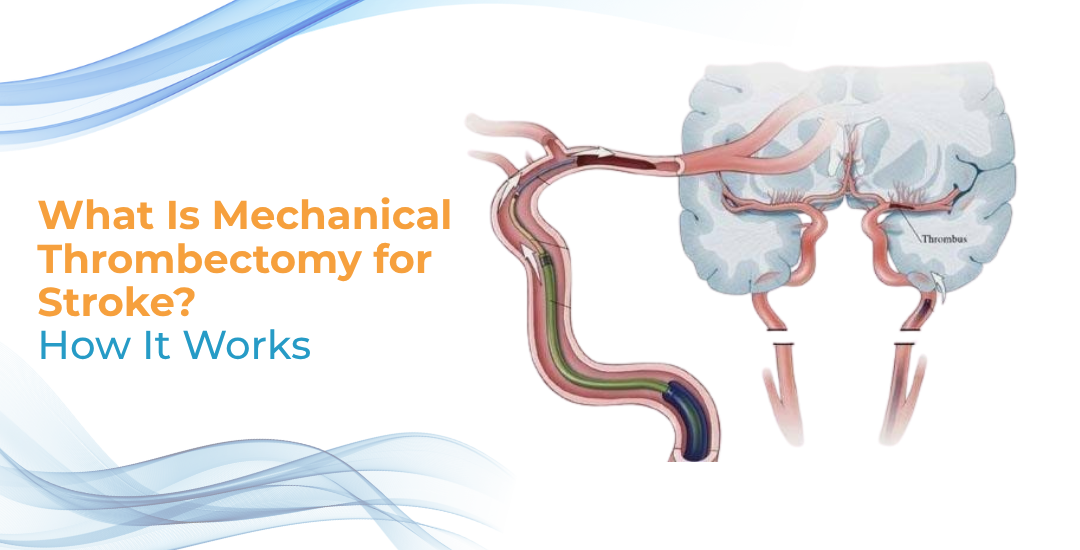
Mechanical thrombectomy and clot-busting drugs treat the same problem in different ways. Drugs dissolve a clot chemically. Thrombectomy removes it physically, using a catheter threaded up to the blocked artery. The distinction matters because the two are suited to different situations, and thrombectomy applies only when a large vessel is blocked. Establishing which vessel is involved decides the entire treatment path.
According to Dr. Savyasachi Jain, an Interventional Neuroradiology specialist, “Thrombectomy is not an option for every stroke. It is designed for large vessel occlusion, and imaging has to confirm that first. Once it does, the clock becomes the only thing that matters.”
Who is mechanical thrombectomy for and when is it done?
Not every stroke qualifies. The procedure targets a large vessel occlusion, meaning a major artery has been shut off. Imaging decides eligibility, not symptoms alone.
- Large vessel occlusion: Big arteries like the carotid or middle cerebral. Smaller vessels are not suited to it.
- Time window: Earlier is better. Selected patients still benefit up to 24 hours out, judged on imaging.
- Salvageable tissue: Scans decide this. Brain that can still be saved strengthens the case.
- Baseline function: How a person was before the stroke feeds the decision, not the stroke alone.
Recognising the warning signs of a brain stroke quickly is what makes the procedure possible at all.
How is mechanical thrombectomy performed?
The procedure works through the blood vessels. There is no open surgery and no incision in the skull.
- Access and navigation: A catheter enters an artery at the groin or wrist. Live X-ray guides it up to the clot.
- Clot removal: A stent retriever grips the clot and pulls it out. An aspiration catheter suctions it away. Sometimes both are used.
- Reopening the vessel: Success is measured by how well blood flow returns. One pass may be enough. Sometimes more are needed.
- Afterwards: Close monitoring follows in a stroke unit or intensive care, watching for bleeding or swelling.
The urgency of vessel imaging applies here just as it does with a dural arteriovenous fistula, where the drainage pattern must be established before anything is decided.
A drooping face, one-sided weakness, or slurred speech signals stroke. Thrombectomy works only within a limited window.
Why Choose Dr. Savyasachi Jain?
Dr. Savyasachi Jain is an Interventional Neuroradiologist and Assistant Professor in Neuroimaging and Interventional Neuroradiology at AIIMS, New Delhi. His work covers vascular conditions of the brain, spine, and head and neck, including image-guided stroke treatment such as thrombectomy.
Thrombectomy depends on rapid imaging, accurate identification of the blocked vessel, and a system that can act without delay. This page is offered as an educational resource on the procedure and is not advice for any individual case.
Frequently Asked Questions
Is mechanical thrombectomy the same as clot-busting drugs?
No. Drugs dissolve a clot chemically. Thrombectomy removes it physically with a catheter. Sometimes both are used together.
Is it brain surgery?
No. It works through the blood vessels using a catheter, not by opening the skull.
Does every stroke patient get a thrombectomy?
No. It is meant for large vessel occlusions, chosen on imaging and timing. Many strokes are treated other ways.
How late can it still be done?
Best early, but selected patients benefit up to 24 hours, decided by brain imaging rather than the clock alone.
References
Disclaimer
This blog is for educational and informational purposes only and should not be considered professional advice.